


“Old Glory”

Betsy Ross Flag

Bennington Flag
Flag Days
New Year’s Day, January 1
Inauguration Day, January 20 (every 4 years)
Martin Luther King Jr.’s Birthday, third Monday in January
Lincoln’s Birthday, February 12
Presidents Day, third Monday in February
Washington’s Birthday, February 22
Easter Sunday (variable)
Army Day, April 6
V-E Day, May 8
Mother’s Day, second Sunday in May
Armed Forces Day, third Saturday in May
Memorial Day (half-staff until noon), the last Monday in May
Flag Day, June 14
Juneteenth, June 19
Father’s Day, third Sunday in June
Independence Day, July 4
Labor Day, first Monday in September
V-J Day, September 2
Constitution Day, September 17
Columbus Day, second Monday in October
Navy Day, October 27
Election Day, first Tuesday after first Monday in November
Veterans Day, November 11
Thanksgiving Day, fourth Thursday in November
Pearl Harbor Day, December 7
Christmas Day, December 25
Other days as may be proclaimed by the President of the United States
The birthdays of States (date of admission)
State holidays
The US Flag
The flag of the United States, often affectionately called “Old Glory” or the “Stars and Stripes”, has undergone a remarkable transformation since the onset of the American Revolution. The first unofficial national flag, the Grand Union Flag of 1775, featured the British Union Jack in the canton, reflecting the colonies’ complex relationship with the Crown at the time. This changed on June 14, 1777, when the Continental Congress passed the first Flag Resolution, officially adopting a design with thirteen stripes and thirteen stars to represent a “new constellation.”
Since those early days, the flag’s design has evolved twenty-seven times as new states joined the Union. A significant shift occurred after the War of 1812; while the flag briefly grew to fifteen stripes and fifteen stars (the version that inspired the “Star-Spangled Banner”), Congress later reverted to the original thirteen stripes to honor the founding colonies, opting to add only stars for new states. The current 50-star flag is the longest-running version in American history, having remained unchanged since Hawaii gained statehood in 1959. Interestingly, the 50-star layout was designed by an 18-year-old high school student named Robert Heft for a class project—his teacher originally gave him a B- for the effort, but famously promised to change the grade to an A if Congress adopted it.
How to Fly the Flag
Here’s a link to an infographic demonstrating the ways to properly fly the flag.
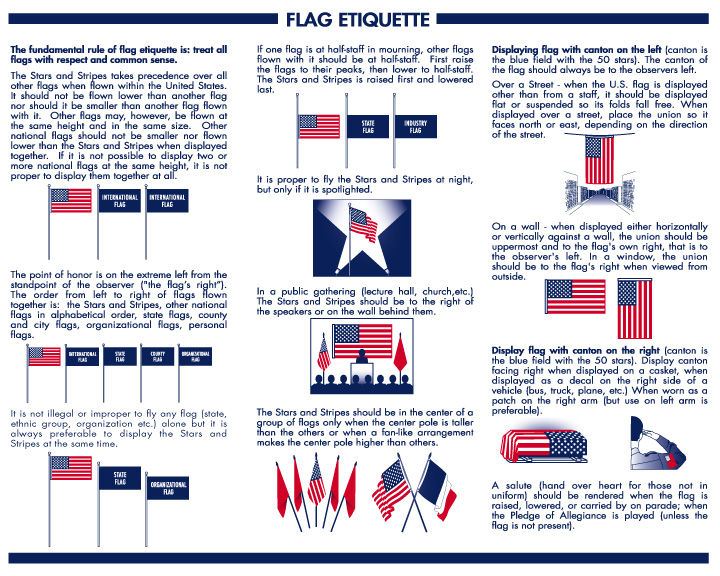
From the Military Veterans Project.org